
Doula vs. Midwife: What's the Difference and Which One Do You Actually Need?

If you're trying to understand the difference between a doula vs midwife, you're not alone. In this guide, you'll learn what each professional does, how they work together, and whether your birth experience may benefit from one, the other, or both.
Quick Links
What Is a Doula?
A doula is a trained professional who provides emotional, physical, and educational support during pregnancy, labor, birth, and the postpartum period. Unlike a medical provider, a doula does not perform clinical tasks or deliver babies. Instead, their focus is on helping parents feel informed, confident, and supported throughout their journey.

A birth doula may:
Provide continuous support during labor
Teach breathing and relaxation techniques
Offer comfort measures such as massage and position changes
Help you understand your options during labor
Encourage and reassure both you and your partner
Support your birth preferences while encouraging informed decision-making
One of the biggest benefits of hiring a doula is continuity. Your doula's only responsibility is supporting you and your family. They stay by your side throughout labor, helping you feel calm and cared for during every stage.
Research has consistently shown that continuous labor support can improve birth satisfaction and may reduce the likelihood of certain medical interventions.
What Is a Midwife?
A midwife is a licensed healthcare provider who manages the medical care of pregnancy, labor, birth, and the postpartum period. Midwives are trained to care for low-risk pregnancies and births and may practice in hospitals, birth centers, or home birth settings.
A midwife can:
Provide prenatal care
Monitor the health of both mother and baby
Order laboratory tests and ultrasounds
Perform physical examinations
Monitor labor progression
Deliver your baby
Recognize complications and arrange additional medical care if needed
Provide postpartum medical follow-up
Midwives combine medical expertise with a philosophy that often emphasizes low-intervention, family-centered care. Many families appreciate the personalized relationship they build with their midwife throughout pregnancy.
Doula vs Midwife: The Biggest Differences
When comparing a doula vs midwife, the most important thing to remember is that they have different roles. One focuses on your medical care, while the other focuses on supporting you throughout the experience.
Medical Care
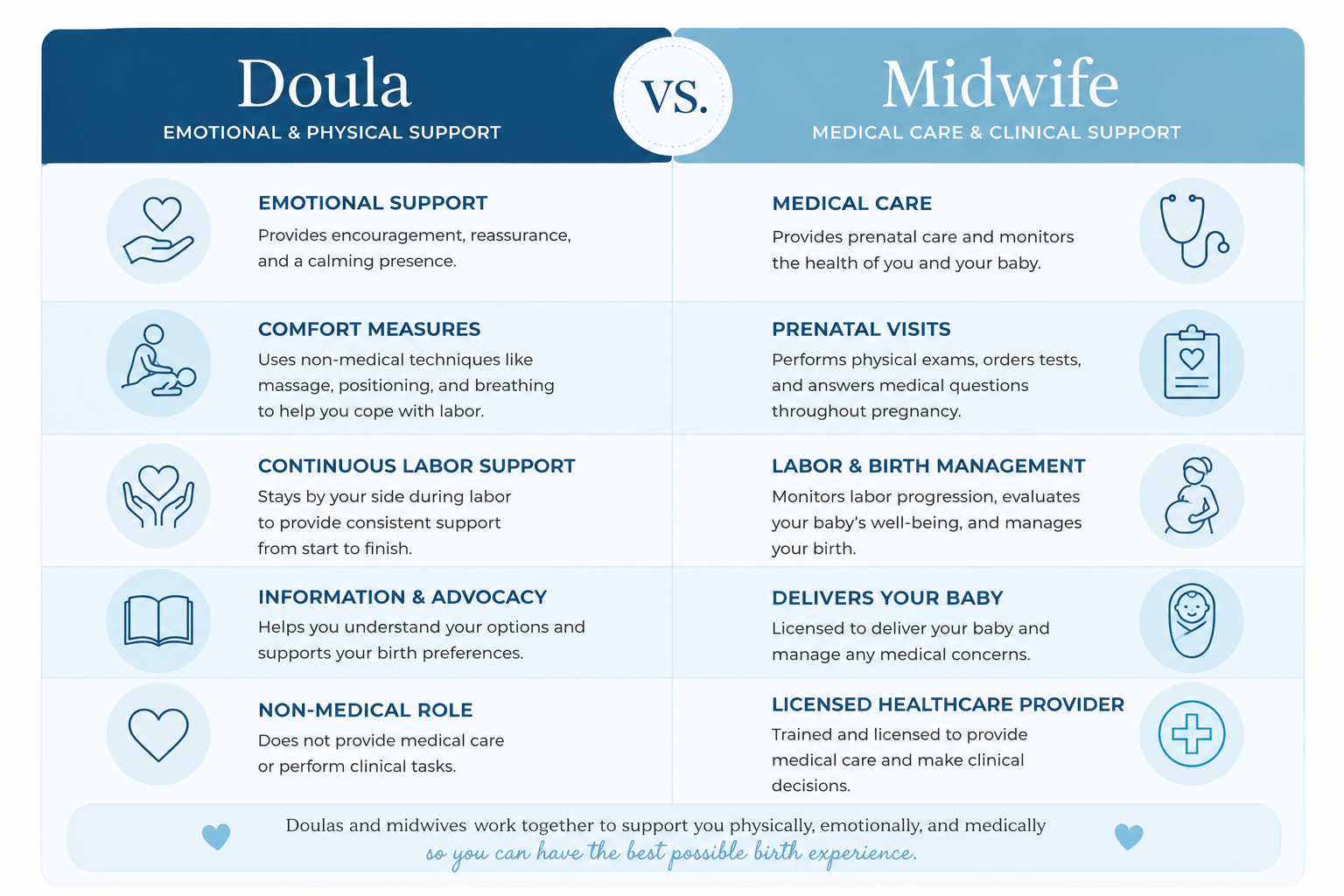
A midwife is a licensed healthcare provider who monitors your pregnancy, manages labor, and delivers your baby.
A doula does not provide medical care or make medical decisions. Instead, they offer emotional, physical, and educational support before, during, and shortly after birth.
Continuous Labor Support
A doula typically stays with you throughout labor, providing consistent support from beginning to end.
A midwife may come and go throughout labor as they care for other patients or attend to clinical responsibilities, depending on the birth setting.
Comfort and Emotional Support
Doulas specialize in helping labor feel more manageable. They use techniques like breathing exercises, massage, position changes, counterpressure, and encouragement to help you stay as comfortable and confident as possible.
Midwives absolutely provide compassionate care, but their primary focus is keeping both you and your baby medically safe.
If you're looking for a quick overview, this comparison chart highlights the biggest differences between a doula and a midwife.
Can You Have Both a Doula and a Midwife?
Absolutely.

In fact, many families find that having both provides the best of both worlds.
Your midwife manages your pregnancy and birth from a medical perspective, while your doula focuses on your comfort, confidence, and emotional well-being.
Rather than overlapping, their roles complement each other.
Many midwives enjoy working with doulas because they know families receive continuous support while they focus on providing excellent medical care.
Whether you're planning a hospital birth, birth center birth, or home birth, having both professionals on your birth team can create a more supported experience.
Which One Is Right for You?
The answer depends on what you're looking for.
If you need someone to provide prenatal care, monitor your pregnancy, and safely deliver your baby, you'll need a medical provider such as a midwife or obstetrician.
If you want someone who offers continuous encouragement, comfort measures, education, and emotional support throughout labor, a doula is an excellent addition to your birth team.
Many families don't choose one over the other.
Instead, they choose both because each professional brings something unique to the birth experience.
Frequently Asked Questions
Can a doula deliver my baby?
No. Doulas are not medical providers and do not deliver babies. Their role is to support you emotionally, physically, and educationally throughout pregnancy and labor.
Can I have both a doula and a midwife?
Yes! Many families choose both because they provide different types of care that work well together.
Is a doula worth it if I already have a midwife?
Many parents say yes. While your midwife manages your medical care, your doula provides continuous support, comfort techniques, education, and reassurance throughout labor.
Is a doula the same as a midwife?
No. Although both support families during pregnancy and birth, a midwife provides medical care while a doula provides non-medical support.
Does insurance cover doulas or midwives?
Midwifery care is often covered similarly to physician care, depending on your insurance plan. Coverage for doulas varies by insurance provider and employer benefits. Some families are also able to use HSA or FSA funds or receive reimbursement through employer-sponsored programs.
Final Thoughts
When comparing doula vs midwife, remember that it isn't about choosing one over the other. Each plays a valuable role in supporting your pregnancy and birth experience. Understanding the differences allows you to build the birth team that best fits your family's needs, giving you both expert medical care and compassionate, continuous support when it matters most.