
Newborn Sleep Schedule by Month: What to Expect in the First 6 Months

Wondering what a newborn sleep schedule actually looks like? This month-by-month guide covers how much babies typically sleep, how sleep changes during the first six months, and what parents can realistically expect along the way.
In this article:
What Does a Newborn Sleep Schedule Look Like?
If you're searching for the perfect newborn sleep schedule, we have some reassuring news: your newborn isn't supposed to have a perfect schedule yet.
During the first few months, babies sleep and wake around the clock. Their tiny stomachs require frequent feedings, and they haven't yet developed the same day-and-night rhythm as adults.
According to the American Academy of Sleep Medicine, infants between 4 and 12 months generally need 12–16 hours of sleep per 24 hours, including naps. Newborn sleep is even less structured, with sleep spread throughout both day and night.
Rather than expecting your newborn to sleep according to the clock, think about their days as a developing rhythm.
Your baby will eat, spend a little time awake, sleep, and begin the cycle again.
Over the first six months, those cycles gradually change. Awake periods become longer. Naps become more predictable. Nighttime sleep may begin happening in longer stretches.
But these changes don't happen on exactly the same timeline for every baby.
That's why a newborn sleep schedule should always be viewed as a general guide rather than a rulebook.
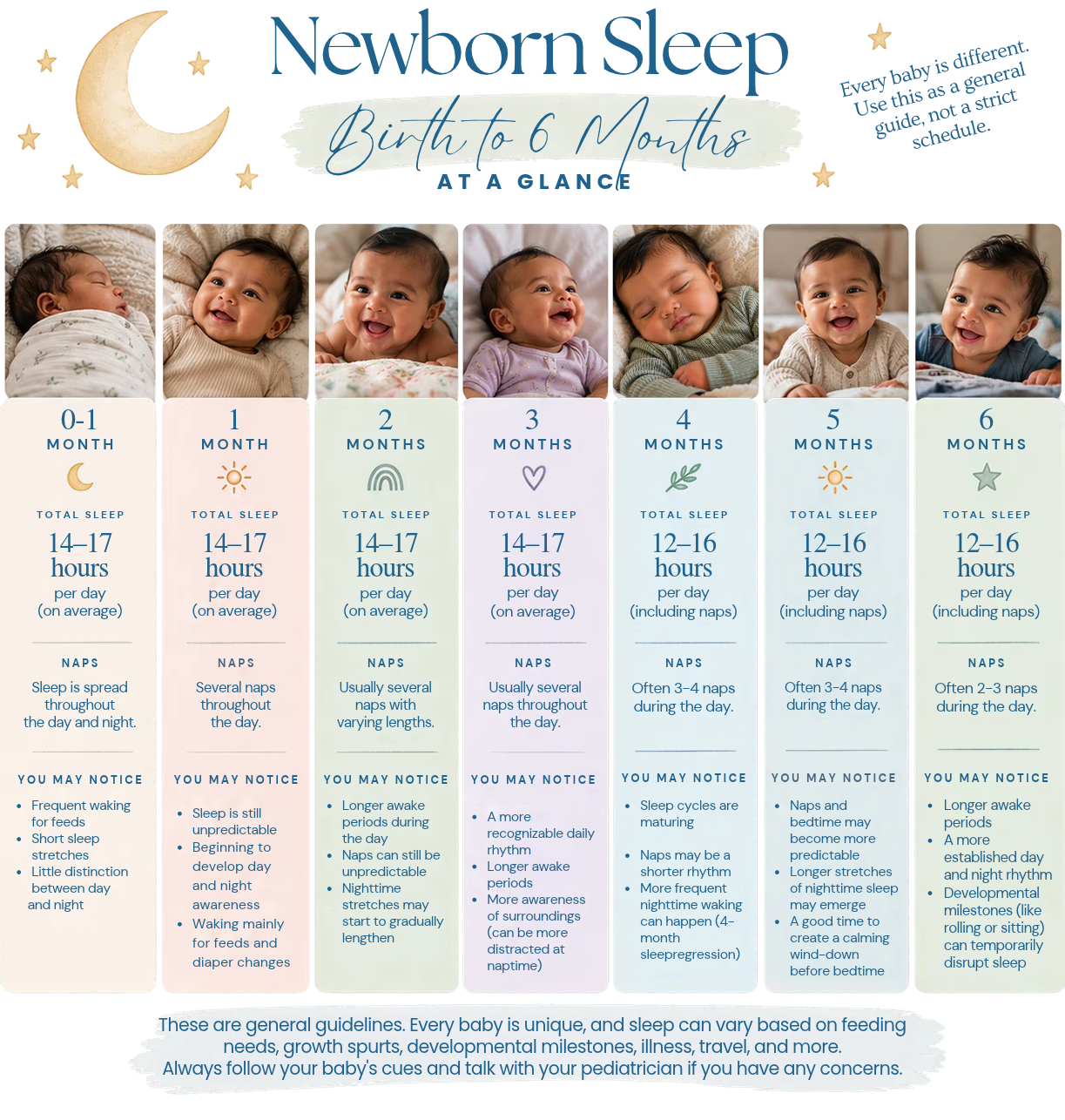
Newborn Sleep Schedule: 0–1 Month
During your baby's first few weeks, sleep can happen at almost any time.
Newborns commonly sleep for much of the day and night, waking primarily to eat, have their diaper changed, and enjoy brief periods of alertness.
There may be very little distinction between daytime and nighttime sleep.
One nap could last 30 minutes. Another stretch of sleep could last several hours. Your baby's feeding needs will also influence how long they sleep between wake-ups.
At this age, don't worry about creating a strict newborn sleep schedule.
Instead, focus on:
Feeding your baby according to your pediatrician's recommendations
Learning your baby's hunger and sleepy cues
Providing opportunities for sleep throughout the day
Practicing safe sleep for every nap and overnight sleep
Giving yourself time to learn your baby's individual patterns
Newborn sleepy cues can include yawning, staring into the distance, turning away, becoming quieter, rubbing their face, or becoming increasingly fussy.
And if your newborn seems to have their days and nights completely confused?
That's incredibly common during the first few weeks.
What Does a 1 Month Old Sleep Schedule Look Like?
At one month old, your baby's sleep will probably still feel unpredictable.
Most one-month-olds aren't ready for a clock-based schedule. Their days continue to revolve largely around feeding and sleeping.
However, you can begin gently helping your baby learn the difference between day and night.
During daytime hours, open the curtains and allow normal household sounds. Talk to your baby during wake periods and get outside for some natural light when you can.
At night, make the environment noticeably different.
Keep lights low. Speak quietly. Keep nighttime feeds and diaper changes calm and relatively boring.
You aren't trying to sleep train a one-month-old or convince them that nighttime waking is bad. They still need responsive care and may need to eat frequently overnight.
Instead, you're beginning to provide consistent environmental cues.
Daytime is bright and active. Nighttime is dark, quiet, and calm.
It may seem simple, but these small differences can support the development of your baby's natural circadian rhythm over time.
What Does a 2 Month Old Sleep Schedule Look Like?
At two months, you may begin noticing longer periods of alertness during the day.
Some babies also begin sleeping for a slightly longer stretch at night, although frequent nighttime waking is still completely normal.
Naps can remain unpredictable.
Your baby might take a wonderfully long nap one afternoon and suddenly become the world's most dedicated 32-minute napper the next.
This isn't necessarily a sign that anything is wrong.
Rather than trying to schedule every nap, start watching for patterns. You may notice your baby naturally becomes sleepy around similar times each day.
Two months can also be a great time to introduce a simple bedtime routine.
It doesn't need to involve seven steps or an elaborate collection of baby sleep products.
Try something like:
Feed → fresh diaper and pajamas → dim lights → cuddle or song → bed
Your baby won't understand the routine immediately. That's okay.
The power comes from repetition. Over time, those familiar steps can become signals that nighttime sleep is approaching.
What Does a 3 Month Old Sleep Schedule Look Like?
Around three months, some families begin seeing something that finally resembles a schedule.
Your baby may stay awake longer between naps. Naps may begin happening around similar times. You might also notice a longer initial stretch of nighttime sleep.
This is a wonderful time to observe your baby's natural rhythm without becoming too attached to exact times.
For example, perhaps your baby usually becomes tired around 9:30 AM.
If they're yawning and fussy at 9:00 one morning, you don't need to keep them awake simply because their “schedule” says 9:30.
Follow your baby before you follow the clock.
Three-month-olds are also becoming much more interested in their surroundings.
Suddenly, the ceiling fan is fascinating. The dog walking through the room is fascinating. Mom's face is fascinating. Everything is fascinating except, apparently, taking a nap.
Because babies become more aware of their environment around this age, some begin sleeping better in a darker and quieter space.
You can continue using a predictable bedtime routine while remaining flexible with daytime sleep.
What Does a 4 Month Old Sleep Schedule Look Like?

Four months can bring one of the biggest sleep changes of your baby's first year.
You may have heard it called the 4-month sleep regression.
But “regression” isn't entirely accurate.
Around this age, a baby's sleep cycles begin maturing and becoming more organized.
That developmental change can temporarily make sleep feel much worse.
You may suddenly notice:
More frequent nighttime waking
Short naps
Difficulty settling for sleep
Increased fussiness around naps or bedtime
Your baby needing more support between sleep cycles
A baby who previously slept for long stretches may suddenly begin waking frequently again.
It can be exhausting, but it doesn't necessarily mean your baby’s routine needs to be completely changed.
Your baby's brain is developing.
During this transition, consistency can be helpful. Continue your bedtime routine, keep nighttime interactions calm, and provide your baby with opportunities for restorative daytime sleep.
Most importantly, remember that development isn't linear.
A difficult week of sleep doesn't erase all the progress you've made.
What Does a 5 Month Old Sleep Schedule Look Like?
By five months, many babies begin developing a more recognizable daily rhythm.
Naps may happen around similar times each day, and bedtime may naturally fall within a more consistent window.
That doesn't necessarily mean your five-month-old will sleep through the night.
Some babies continue waking for nighttime feeds. Others begin sleeping longer stretches. Feeding needs, growth, temperament, development, and many other factors influence nighttime sleep.
This can also be a wonderful age to start bedtime before bedtime.
About 20–30 minutes before beginning the actual bedtime routine, start slowing the house down.
Dim the lights. Lower the television or music. Put away highly stimulating toys. Speak a little more quietly. Spend some time cuddling, reading, or playing calmly.
Then transition into your normal bedtime routine.
Babies can't look at a clock and realize it's almost bedtime. Instead, they learn from predictable cues in their environment.
Creating that gradual transition can make bedtime feel less like an abrupt stop to the day and more like a natural progression toward sleep.
What Does a 6 Month Old Sleep Schedule Look Like?
By six months, many families finally feel like their baby's days have become somewhat predictable.
Many six-month-olds take two or three naps each day and have longer periods of awake time between naps. Nighttime sleep may also occur in longer stretches.
But even a great routine can suddenly change.
Around six months, babies are busy learning.
Rolling, sitting, babbling, reaching, grabbing, and becoming increasingly mobile are exciting developmental milestones.
Unfortunately, some babies decide that 2 AM is the perfect time to practice them.
Teething, illness, growth spurts, travel, feeding changes, and developmental milestones can all temporarily disrupt sleep.
That's why we prefer to think of a six-month sleep schedule as a framework rather than something that needs to happen at exact times every day.
Predictability can be helpful.
Rigidity usually isn't.
If your baby skips a nap, sleeps somewhere different, or has a rough night, you haven't ruined their schedule. Return to your normal rhythm when you can.
How Can You Help Your Baby Develop Healthy Sleep Habits?
As you've probably noticed throughout this guide, healthy sleep habits don't require a complicated routine. While your baby's sleep needs will change significantly during the first six months, a few simple habits can help create consistency along the way.
To recap:
Keep bedtime predictable. A simple routine like feeding, pajamas, dim lights, a book or song, and cuddles can help signal that sleep is coming.
Help baby learn day from night. Keep daytime brighter and more active while making evenings darker, quieter, and calmer.
Watch your baby, not just the clock. Learn their individual sleepy cues and offer opportunities for rest when they show you they're tired.
Give yourself flexibility. Growth spurts, developmental milestones, illness, travel, and sometimes seemingly nothing at all can change your baby's sleep.
Remember that awake time doesn't need to be scheduled either. Your baby doesn't need constant entertainment. Watching you fold laundry, listening while you make lunch, or sitting outside together provides plenty to take in.
The goal isn't to create a “perfect sleeper.” It's to build familiar, reassuring rhythms while responding to the baby in front of you.
What If My Baby Doesn't Follow a Typical Newborn Sleep Schedule?
Here's something we wish more new parents heard:
Your baby's sleep schedule isn't a report card.
You can find beautifully organized sample schedules online that tell you exactly when a three-month-old should wake, nap, eat, and go to bed.
Your baby has not read those schedules.
Two healthy babies of exactly the same age can sleep very differently.
One may take several short naps. Another may prefer fewer, longer naps. One may begin sleeping longer stretches overnight early. Another may continue needing nighttime feeds.
Sample schedules can help you understand general patterns. They shouldn't make you feel as though something is wrong because your baby's day looks different.
Pay attention to your baby's cues, feeding needs, temperament, and development.
And trust yourself, too.
If your baby's sleep changes dramatically, they are unusually difficult to wake, aren't feeding well, or you have concerns about their sleep or development, reach out to your pediatrician.
Sometimes reassurance from someone who knows your baby is far more valuable than another sleep schedule from the internet.
What Are the Safe Sleep Guidelines for Babies?
No newborn sleep schedule is more important than safe sleep.
The American Academy of Pediatrics recommends placing babies on their backs for every sleep on a firm, flat sleep surface designed for infant sleep.
Keep your baby's sleep space free from loose blankets, pillows, stuffed animals, bumpers, and other soft items.
Room sharing without bed sharing is also recommended for at least the first six months.
Parents and caregivers should follow current guidance from the American Academy of Pediatrics’ safe sleep resources and talk with their pediatrician about any questions specific to their baby.
Safe sleep recommendations can change as new research becomes available, so it's always worth checking current guidance rather than relying on advice that was passed down from previous generations.
How Can a Postpartum Doula Help With Newborn Sleep?

Sometimes the thing exhausted parents need most isn't another newborn sleep schedule.
It's sleep.
A postpartum doula can support your family while you're learning your baby's rhythms and adjusting to life with a newborn.
Depending on your family's needs, postpartum support may include newborn care, feeding support, bottle washing, baby laundry, education, light household support, and helping parents become more confident reading their baby's cues.
Overnight postpartum care can be especially valuable.
While your doula cares for your baby between feeds or handles other newborn needs, parents can have an opportunity to get longer stretches of much-needed rest.
At Silver Lining Doula & Nanny Services, our goal isn't to make every newborn fit into the same schedule. It's to support families through this season while they learn what works for their baby.
You may enjoy: When Should You Hire a Postpartum Doula?
The Bottom Line on Newborn Sleep Schedules
Your baby's sleep will change tremendously during the first six months, and there isn't one newborn sleep schedule that works for every baby. Focus on safe sleep, predictable routines, your baby's individual cues, and giving both your baby and yourself plenty of grace as you find your rhythm.
Need a little more support during the newborn months? Silver Lining's postpartum doulas provide daytime and overnight support to help families rest, recover, and feel more confident as they settle into life with a new baby. Learn more about our postpartum doula services.